Your Register Already Wrote Next Week's Schedule
Picture a Saturday morning at a gun counter. One of your most experienced people is walking a first-time buyer through a 4473. Two customers are leaning on the handgun case, and a third is holding a box of ammunition and looking at the door. Eventually he decides he can buy that box somewhere else, and he leaves.
Now picture the following Tuesday at two in the afternoon. Three people are on the clock. One is restocking a shelf that was already mostly full, one is cleaning glass that was already clean, and one is on the phone with a distributor about a backorder. Nobody has walked in for forty minutes.
Nobody had to be lazy or careless for either of those scenes to happen. The schedule was simply built the way most schedules are built, from memory and habit and the way it was done last year, instead of from the receipts sitting in the register.
Most Schedules Are Built From Memory
Ask most store owners when they are busiest and they will answer quickly. Saturdays, obviously. The week before deer season. Black Friday. They are usually right about the big days and less sure about the hours in between, because nobody remembers a slow Wednesday.
Researchers at Wharton have spent years studying how retailers set staffing, and they found the most common industry practice is to set store labor in proportion to forecasted revenue. When Marshall Fisher, Santiago Gallino and Serguei Netessine tested a more careful, store-by-store method at a large specialty retailer, the implementation in 168 stores over six months produced "a 4.5% revenue increase and a nearly $7.4 million annual profit increase." They also found that "the impact of staffing level on revenue varies greatly by store." What works for the store across town tells you very little about what works for yours.
The Wrong Person at the Wrong Hour Costs More Than You Think
Another team of researchers looked at hour-by-hour traffic, sales and labor in 41 stores of a large retail chain. They found "significant understaffing during a three hour peak period in all 41 stores." They estimated the cost of that understaffing at 6.15 percent of sales and 5.74 percent of profitability, while overstaffing cost about 2.04 percent of profitability.
Being a little heavy on a slow afternoon hurts. Being short at the moment customers are actually in the building costs nearly three times as much in profit.
Zeynep Ton at MIT has made a similar point for years. In her work with retail chains, she saw "strong correlations between indicators of bad jobs, such as high turnover and frequent lastminute schedule changes, and costly operational problems, such as stockouts, inventory shrinkage and inaccuracies, and low conversion rates." When the floor is thin at the wrong time, the counter is not the only thing that suffers. Receiving falls behind, counts drift, and the product a customer asked for is sitting in the back room where nobody has had time to put it out.
A Gun Counter Is Not a Checkout Lane
All of that research comes from general retail, where most transactions take a minute or two. A firearms counter has its own math.
ATF's own paperwork estimate for Form 4473 is 30 minutes per form. The agency proposed changes this year that it says "would reduce the time burden from 30 minutes to 15 minutes per form," but in July it asked to keep the existing form in place while it works through public comments. That estimate covers the form, not the conversation that comes before it, the background check, or the customer who wants to talk about optics while he waits.
In practice, one firearm sale can occupy your most knowledgeable employee for a meaningful part of an hour. Add transfers, NFA questions, special orders, and a range with lanes, rentals, classes and safety officers, and the question of who is on the clock at 11 on a Saturday is about much more than coverage. It is about whether the person who can actually close that sale is standing there when the customer walks in.
What the National Numbers Say, and What They Cannot
The FBI publishes the number of NICS firearm background checks for every day going back more than two decades, so I pulled that data apart by day of the week. Between 2000 and 2025, Fridays averaged about 69,000 checks a day, the highest of any day. Saturdays averaged about 60,000, a little more than Tuesdays through Thursdays. Sundays averaged under 29,000. Friday stayed on top and Sunday stayed at the bottom over the last three years and so far in 2026, and lately Saturday has actually trailed the middle of the week. Nationally, Saturday is not the busiest day of the week. Friday is.
The calendar shows the same thing on a larger scale. December was the busiest month for NICS checks in 18 of the 26 years from 2000 through 2025. In every year from 2015 through 2025 except 2020 and 2021, Black Friday was the single busiest day of the year. This year, Black Friday falls on November 27. NSSF has worked with retailers to spread Black Friday offers across the week so the system is not overwhelmed on one day, and that same idea works inside your own store.
These numbers come with limits. The FBI says plainly that background checks "do not represent the number of firearms sold," and the totals include permit checks along with sales. They are national, and your store is not. The FBI also does not publish anything by the hour, so the most useful map of your business is not in Washington. It is in your own register.
Draw the Heatmap
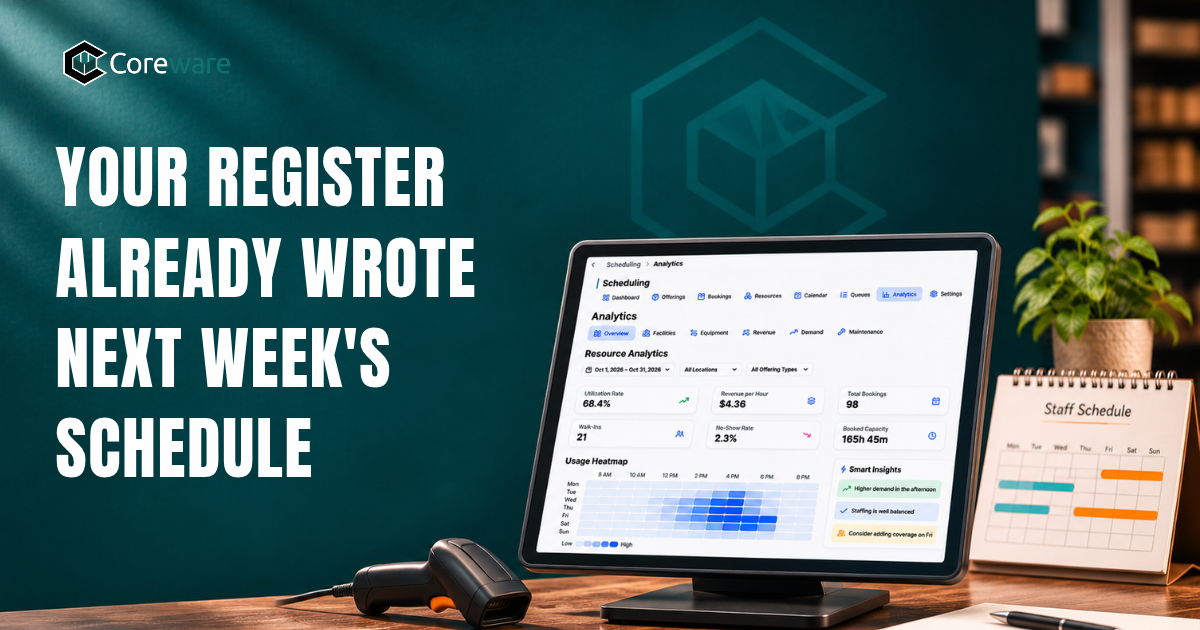
Suppose you pulled the last twelve weeks of sales from your point of sale and laid them out on a simple grid, with days of the week across the top and hours of the day down the side. Shade each square by sales. Then lay your schedule for the same weeks right next to it.
The following is a hypothetical, but it is the kind of thing owners tend to find. Saturday from 10 to 1 is dark, which you expected. Thursday from 5 to 7 is nearly as dark, because that is when people stop in after work, and it has been staffed like a slow evening for years. Tuesday morning is pale, and it has three people on it because that is when the truck used to come. Sunday afternoon is busier than Sunday morning, so the person who opens on Sunday may be better used at 1 than at 9. None of that requires new employees. It may only require moving two shifts.
A range can do the same with lane reservations and walk-ins. If lanes fill at 6 on weeknights and sit half empty at 2, your safety officers, your rental counter and your most patient instructors should be scheduled to match.
Predictable Beats Perfect
There is a temptation, once you see the heatmap, to start shuffling people hour by hour every week. The research says that is a mistake.
In a randomized experiment at 28 Gap stores, researchers from the University of Chicago, UC Hastings and the University of North Carolina made schedules more consistent and predictable and gave employees more input. Store productivity rose 5.1 percent, the result of a 3.3 percent increase in sales and a 1.8 percent decrease in labor. They also found that only 30 percent of the variability in weekly payroll hours was explained by changes in traffic. Most of the chaos came from everything else.
Unstable schedules also drive people out the door. The Shift Project, which has surveyed thousands of retail and food service workers, found that exposure to schedule instability is "a strong, robust predictor of turnover." Replacing someone is expensive. A 2012 Center for American Progress review estimated the typical cost of turnover for positions earning under $30,000 a year at 16 percent of annual salary.
Matching staff to sales means building a steady base schedule that fits how your business actually behaves, then leaving it alone long enough for your people to plan their lives around it.
Put Your Best People Where the Business Is
Once you can see the busy hours, you can decide who belongs in them. The employee who knows NFA paperwork and transfers inside and out belongs on Friday afternoon and Saturday morning. The one who is meticulous about receiving and counts may be most valuable on a quiet Tuesday. Your best closer should not be the person who always gets Monday mornings because he asked for them three years ago. From the customer's perspective, none of this is visible. He simply walks in and finds someone who knows the answer and has time to help.
Try It for One Week
You do not need to rebuild your schedule to start. Pull the last eight to twelve weeks of sales by day and hour. Print it. Pencil in who was working each block. Look for three places where the darkest squares had the thinnest coverage, or the palest squares had the most. Move one shift and watch what happens over the next month. You may find the busiest hour in your store is not the one you think it is. Your register has been keeping track of when customers show up for years. It is simply waiting for someone to read it.
Coreware connects your point of sale, inventory, eCommerce, compliance and marketing in one platform, with reporting that provides "insights into sales, inventory, and employee performance." For ranges, Coreware handles lane scheduling, reservations, classes and instructor scheduling, and its utilization and peak-time data "support better staffing, pricing, and promotional decisions." Reports can be saved and scheduled to run automatically, so the picture of your busy hours arrives without anyone having to remember to pull it.
Everything you've read here can be found on our platform. To learn more, visit coreware.com.